

 Posted by
When you are driving or riding, whether you just ride for pleasure or commute, we all face the risk of committing a road traffic offence all the time we are out on the road. Although we might all think we are the best driver/rider out there on the road, it is easy to accumulate penalty points for exceeding the speed limit or passing through a red light, and all too quickly those points can mount up.
Points on your licence can be accumulated for a number of offences, for example:
- Speeding
- Running a red light
- Driving while using a mobile phone
- Failing to stop after an accident
- Driving a vehicle with defective tyres or brakes
- Careless driving
The minimum number of points that can be issued per offence is 3 – and the maximum is 11. As you would expect, the more serious the offence, the more points you will be awarded!
So, how many points can you have on your licence and still drive? Well, technically if you have held your licence for more than two years, accumulating 12 or more penalty points within a 3 year period will lead to a driving ban. This is commonly known as ‘totting up’ which will usually result in a minimum 6 month driving disqualification. Of course there are exemptions to this which is why I say technically!
If the ‘totting up’ rule is applied, then while 12 points is the threshold, the courts have the power to use their discretion to not enforce a ban if the driver will face an “exceptional hardship”. This means some drivers may have more than 12 penalty points.
However, if you have held your licence for less than two years, 6 or more points will result in your licence being revoked. If this happens, you will have to apply and pay for a new provisional licence and pass both theory and practical parts of the driving/riding test again.
Points will stay “active” on your licence for a period of 3 years.
If you accumulate points whilst holding a provisional licence, these will carry over onto your full licence once obtained.
Depending on the type of motoring offence, as well as endorsing your licence, the courts can also issue you with a fine.
Endorsements and penalty points are put on your driver record. You can view your driving record yourself by going onto the gov.uk website, you will need to enter your driving licence number, National Insurance number and the postcode on your driving licence.
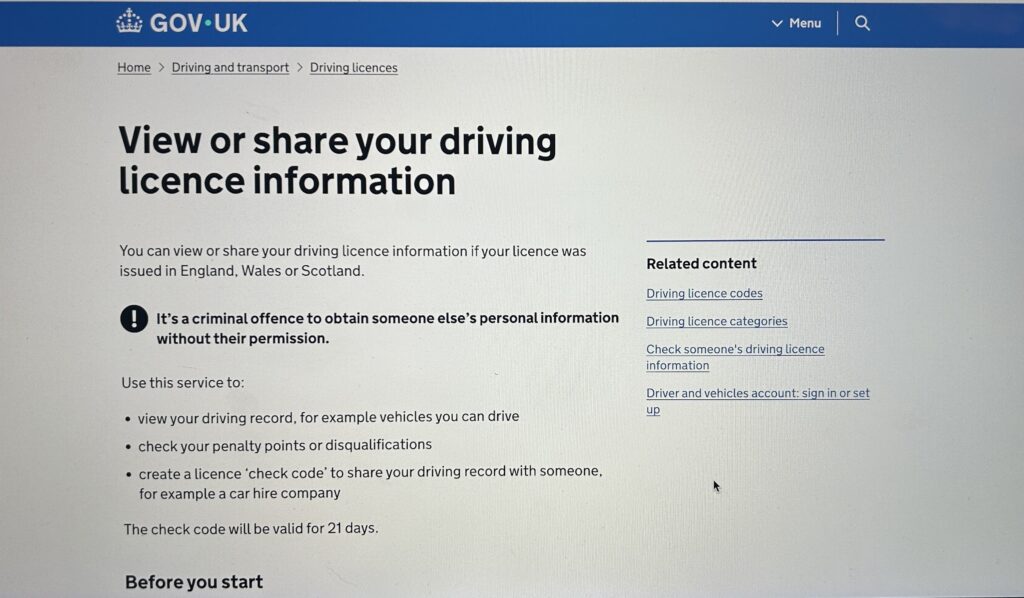
Here you can see your driving record, the vehicles you can drive, check your penalty points or disqualifications and when they will be removed. You can also create a licence ‘check code’ if you need to share your driving record with someone, for example, a car/bike hire company or a dealership if you want to test ride a car/bike. This code is valid for a period of 21 days.
Endorsements have to stay on your driving record for 4 or 11 years, depending on the offence.
There are certain non endorsable offences where the court can impose a fine but no penalty points.
Did you know that, under the ‘totting up’ process, penalty points are accumulated from the date of the offence, not from when the courts impose the points. For example, if you had nine points on your licence and three points were due to expire before you go to court for another offence, then these three points will still count towards your total if they were on your licence at the time of the most recent offence. Under the totting up process, you will still have reached 12 points.
Incidentally, you will probably find that having penalty points on your licence or being disqualified from driving will increase your insurance premium.
If you drive for work you may not be able to continue in your current role. You may be lucky in that your employer might be lenient about this and offer you a different position for the duration of your ban, or you could potentially lose your job.
Day to day driving will stop of course, for example, running the kids or elderly relatives around.

Your hobbies outside of work will be limited too, for example, if you just ride a motorbike for pleasure, there will be no Sunday morning ride outs with your mates to find breakfast.
This is where technically comes in again, as of course there are exceptions to the minimum six month disqualification if you have 12 points.
The most common way is to demonstrate to the court that a disqualification will lead to ‘exceptional hardship’. It is important to note here that there is a significant difference between ‘hardship’ and ‘exceptional hardship’.
As you would expect, most people who lose their licence will be severely impacted, and this is a natural consequence of the offence committed which has to be accepted. Where exceptional hardship will be considered is, for example, where the courts learn that people who are wholly innocent of any offence will also be impacted.
In such circumstances you will need to present evidence of how your inability to drive will cause suffering and what impacts it will create. This needs to be carefully prepared and presented, and, in my opinion, you need specialist legal assistance for this.
Knowing and understanding the law and how it works can be a minefield which is why it is always a good idea to seek the advice of people who do know and understand it. Did you know that the Solicitors at White Dalton are all bikers themselves so they ‘get it’. If you need advice, check out their website at White Dalton Motorcycle Solicitors

So, we need to be aware of the speed limits and make sure we don’t get into trouble as the implications for us are likely to affect not just our day to day life, but also our hobby, and we run the risk of not getting out on a Sunday morning ride out with our mates to find that perfect bacon sarnie.
BK
#realbikersreallawyersrealanswers
#callusbeforewecallyourinsurer